Tinker Corps
On this page
Tinker Corps is a combining game for children. It is the one FDT product that does not wear the FDT brand: no navy, no Inter, no Barlow Condensed, no tactical register. Everything on this page is for Tinker Corps only.
Typefaces
Two rounded families, each with one job.
Fredoka
| Attribute | Value |
|---|---|
| Role | Display: titles, headings, buttons, item names |
| Weights | 500, 600, 700 |
| Case | Sentence case. Never all capitals. |
| Rule | Never used for a paragraph. Two lines is the limit. |
| Source | Google Fonts · SIL Open Font License 1.1 |
| File | /fonts/tinker-corps/fredoka-latin-wght.woff2 (variable, weight 300 to 700, Latin subset) |
| Fallback stack | Fredoka, Nunito, ui-rounded, system-ui, sans-serif |
Nunito
| Attribute | Value |
|---|---|
| Role | Body, labels, small print |
| Weights | 400, 600, 700, 800 |
| Case | Sentence case. Small labels may be capitals at 800, tracked 0.08em, set by the stylesheet and never typed. |
| Rule | Body text is at least 16 pixels, with a line height of 1.5 or more. |
| Source | Google Fonts · SIL Open Font License 1.1 |
| File | /fonts/tinker-corps/nunito-latin-wght.woff2 (variable, weight 200 to 1000, Latin subset) |
| Fallback stack | Nunito, ui-rounded, system-ui, sans-serif |
Hosting
Both files are self-hosted. A product for children makes no request to a third-party font service, so nothing loads them from Google Fonts. The copies here are the reference; the website serves its own from the CDN.
Icons
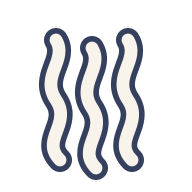
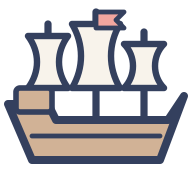
Every discovery in the game has one drawing, used at every size: on the workbench, in the drawer, on the website and as an alternate app icon.




Drawing
| Attribute | Value |
|---|---|
| Canvas | viewBox="0 0 48 48", exported at 192 by 192 |
| Format | SVG, path elements only: no groups, text, gradients, filters or embedded images |
| Root element | Sets stroke-linecap="round" and stroke-linejoin="round" once, and nothing else: no stroke, no fill |
| Outline | The shapes that make the silhouette carry stroke="#34405E" at stroke-width="2", set on each path. It is by far the most common stroke in the set. |
| Inner lines | The same colour, thinner: 1 to 1.8 units, for detail inside a shape |
| Inner fills | A highlight or a panel inside an outlined shape may have no stroke at all |
| Heavy strokes | 2.2 units and up are for a line that is itself the object (a rope, a beam, a wisp of steam) and for the carrier described below |
| Fill | Flat colour, set on the path, or fill="none" for a line. Never a gradient. Start from the palette below. |
| Safe area | Keep paths about 4 units in from the edge, so the outline never touches it |
| Background | Transparent. The plate supplies the colour. |
| File name | The discovery’s name as a kebab-case slug: Ship's Cat is ships-cat.svg |
| Size | About 2 KB at most. The average is 800 bytes. |
A drawing shows one idea: usually a single object, front-on or three-quarter. It may stand on a ground line, and one small companion may name it, as the Moon does behind the Moon Tree above. No cast shadow and no scene. If it needs a label to be understood, redraw it.
A light stroke on a light plate gets a carrier: draw the stroke twice, first in the outline colour, then in the light colour, narrower, on top. Steam, above, is drawn that way, at 6 units under 3.2. This is the one place a stroke is not the outline colour.
Palette
Start from this set. It accounts for four fifths of the fills in the 403 drawings so far. The rest are one-off colours an object needed, such as an olive (#A2B28D) or a charcoal (#3B4252): add one when nothing here will do, keep it in the same soft range, and never use pure black.
#34405E White
#FFFFFF Cream
#F8F3EB Mist
#DDE4EE Steel
#CDD5DF Slate
#8D96A6 Butter
#FAE494 Peach
#F7BC8C Coral
#F2A69F Red
#E0584F Pink
#F7C8D4 Tan
#D1B296 Bark
#BC9F89 Leaf
#B3DDA9 Sage
#BECD9E Sky
#ABD5FF Ice
#E3F1FF
Red is the strongest colour in the set. Use it for the part of a drawing that should be seen first.
Plate
Wherever a discovery is shown as a discovery (the workbench, the drawer, the collection, the website), its drawing sits on a plate that says which era it belongs to. The one exception is an alternate app icon, described below, where the drawing stands alone.
| Attribute | Value |
|---|---|
| Shape | Square, corner radius a quarter of its side |
| Fill | The era’s tint |
| Border | The era’s accent, 3 pixels |
| Drawing | Centred, about three quarters of the plate’s side |
| Smallest size | 44 by 44 pixels where it can be pressed |
Each era has one accent and one tint. The game’s data/game.json is the source; this table is a copy of it, in display order.
| Era | Slug | Accent (border) | Tint (fill) |
|---|---|---|---|
| Starters | starters |
#3E62AD |
#E4EBF9 |
| Timeless: Nature | nature |
#7C8BA6 |
#F4F6FA |
| Timeless: Materials, Camp & Food | stuff |
#7C8BA6 |
#F4F6FA |
| Timeless: Animals | animals |
#7C8BA6 |
#F4F6FA |
| Stone Age | stone |
#9C846B |
#F1EBE4 |
| Ancient World | ancient |
#D9824A |
#FBE8DB |
| Medieval | medieval |
#8F63B8 |
#EFE6F7 |
| Gunpowder & Sail | sail |
#2F86D6 |
#DDEDFB |
| Industrial Age | industrial |
#6E7B91 |
#E5E9F0 |
| World War I | ww1 |
#B8953E |
#F6EFDB |
| World War II | ww2 |
#6F8B3C |
#E6EEDA |
| Cold War | cold |
#2FA3A8 |
#DAF1F1 |
| Modern | modern |
#CF5C93 |
#F9E2EE |
| Space Age | space |
#4F55C4 |
#E2E3F8 |
The three Timeless groups share one frame. A new era needs a row in data/game.json first.
The accents are not strong borders: against their own tints they measure between 2.4 to 1 (Ancient World, World War I) and 4.9 to 1 (Starters), and four of them fall below 3 to 1. That is acceptable only because the border is decoration.
The era is always named in text beside the plate or in its spoken name. The border colour alone never carries it: several accents are blues that sit close together.
A plate at rest wears its era’s border. Any other state (picked up, hinted, new) wears a wider, dark border, never a different accent colour.
A discovery with no drawing yet shows its first letter on the plate, in Fredoka Bold.
App icons
The alternate app icons reuse the item drawings.
| Attribute | Value |
|---|---|
| Source | The item drawing of the same slug, unchanged |
| Background | White, edge to edge |
| Framing | The drawing fills the icon. No plate, no border, no rounded mask of our own: the system applies its mask. |
| Size | 1024 by 1024, rendered from the SVG |
Coo

Coo, the messenger pigeon, is the guide. Coo is drawn on a 200 by 224 canvas, tall enough to hold the outline of the shadow Coo stands on, with the same outline colour at 3 to 5 units, which matches the item outline when Coo is shown about twice the height of a plate. Coo’s lilac greys are Coo’s own and are not item colours. Coo delivers hints and announcements; Coo never appears on a plate and is never an item.
Never
- Fredoka or Nunito outside Tinker Corps, or an FDT typeface inside it.
- An FDT token (
--fdt-*) in a Tinker Corps stylesheet. The game and its website have their own (--tc-*). - Font Awesome glyphs or APP-6D symbols as discoveries. Every discovery is drawn.
- A gradient, a drop shadow or a texture on a drawing or a plate.